Tour de France 2026 runs from July 4 to July 26, covering 3,333 kilometers across 21 stages. Barcelona hosts the Grand Départ for the first time, opening with a 19.7-kilometer team time trial at Montjuïc Olympic Stadium. The route features 54,450 meters of climbing, five summit finishes, and back-to-back Alpe d’Huez stages on Days 19 and 20.
Tadej Pogačar enters as the favorite, chasing a record-tying fifth yellow jersey. Jonas Vingegaard and Remco Evenepoel lead the challenge. This guide covers the complete route breakdown, stage-by-stage details, team strategies, and where to watch live.
Tour de France 2026 Overview – Dates, Format & Key Facts
Tour de France 2026 is the 113th edition and runs from 4–26 July 2026, with 21 stages from the Grand Départ in Barcelona to the final stage in Paris. The official route totals 3,333 km and about 54,450 m of vertical gain, which sets up a climbing-heavy race with clear GC pressure.
The opening format is the headline change. Stage 1 is a Barcelona team time trial of about 19.7 km, bringing back a TTT start that the Tour has not used in decades. Stage times are taken under updated rules, so early gaps can immediately affect general classification.
A second time trial arrives later: Stage 16 is a 26 km individual time trial between Évian-les-Bains and Thonon-les-Bains, adding a late-race test for GC contenders. The peloton size is fixed at 184 riders from 23 teams, and the race includes two rest days.
Official Route & Stage Breakdown
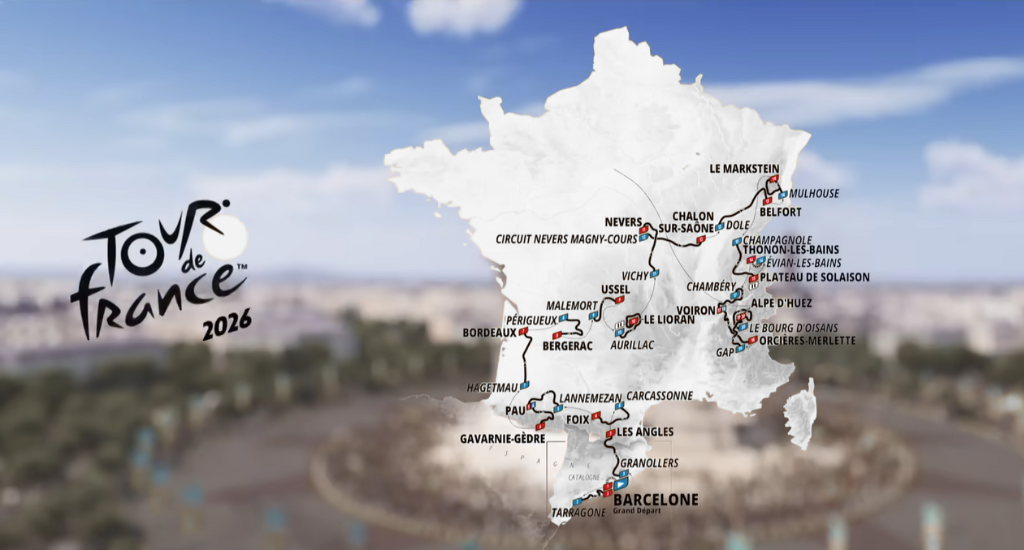
The Tour de France 2026 covers 3,333 kilometers and features a total elevation gain of 54,450 meters. The race runs from July 4 to July 26, with 21 stages across two countries. The route includes 8 mountain stages, with 5 summit finishes at Gavarnie-Gèdre, Plateau de Solaison, Orcières-Merlette, and Alpe d’Huez.
Key terrain breakdown: seven flat stages, four hilly stages, one team time trial, and one 26-kilometer individual time trial near Lake Geneva. The Col du Galibier reaches 2,642 meters, marking the highest point of the race. Rest days fall on July 13 and July 20.
Grand Départ & Catalonia Start
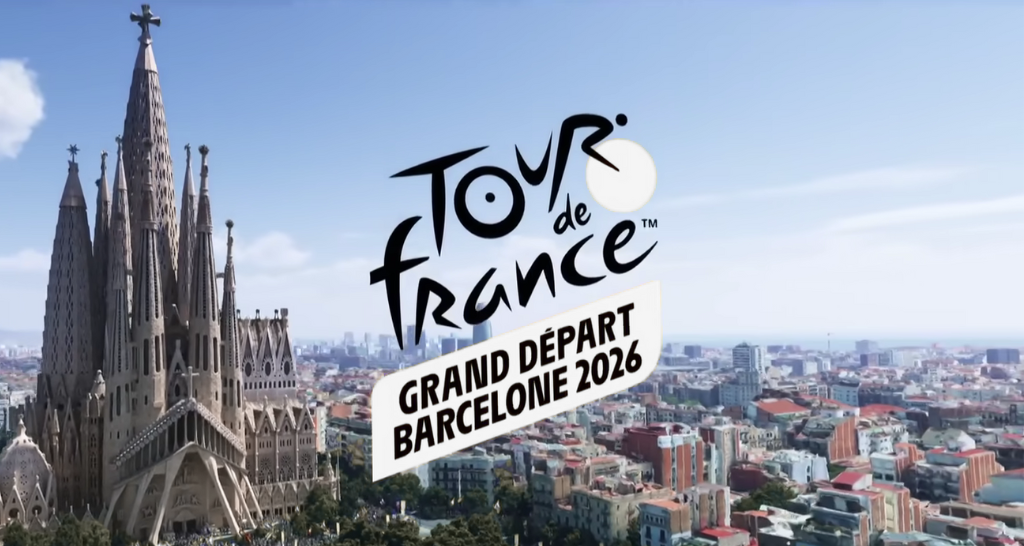
Barcelona hosts the Grand Départ for the first time, marking the fourth time the city has welcomed the Tour, after stages in 1957, 1965, and 2009. Stage 1 is a 19.7-kilometer team time trial departing from Fòrum on the Mediterranean coast, passing the Olympic Port, and finishing at Estadi Olímpic Lluís Companys.
Spectators can watch riders pass Gaudí’s Sagrada Família before teams tackle two climbs up to Montjuïc Olympic Stadium. Stage 2 from Tarragona showcases coastal towns, including Sitges, along panoramic Mediterranean sea views before three laps of the Montjuïc finishing circuit. Stage 3 departs Granollers, home to the Barcelona-Catalunya Formula 1 circuit, heading toward the French border.
Mountain Stages & Key Climbs Across the Pyrenees and the Alps
The Pyrenees arrive early on Stage 6, featuring the Col d’Aspin and Col du Tourmalet before finishing near the enchanting Cirque de Gavarnie with 4,150 meters of climbing. This summit finish marks Gavarnie’s Tour debut.
Stage 15 introduces the Plateau de Solaison for the first time – an 11.3 kilometer climb averaging 9.1%. The decisive GC battles unfold on Stages 19 and 20. Stage 19 is a short 128-kilometer explosive day from Gap, tackling the Col Bayard, Col du Noyer, and Col d’Ornon before the classic 21 hairpins of Alpe d’Huez.
Stage 20 delivers the queen stage: 171 kilometers with 5,600 meters of elevation gain, including the Col de la Croix de Fer, Col du Télégraphe, and Col du Galibier, then finishing at Alpe d’Huez via the Col de Sarenne. This double ascent of Alpe d’Huez marks the first time since 1979 that the climb features back-to-back summit finishes.
Paris Finale – Montmartre + Champs-Élysées Context
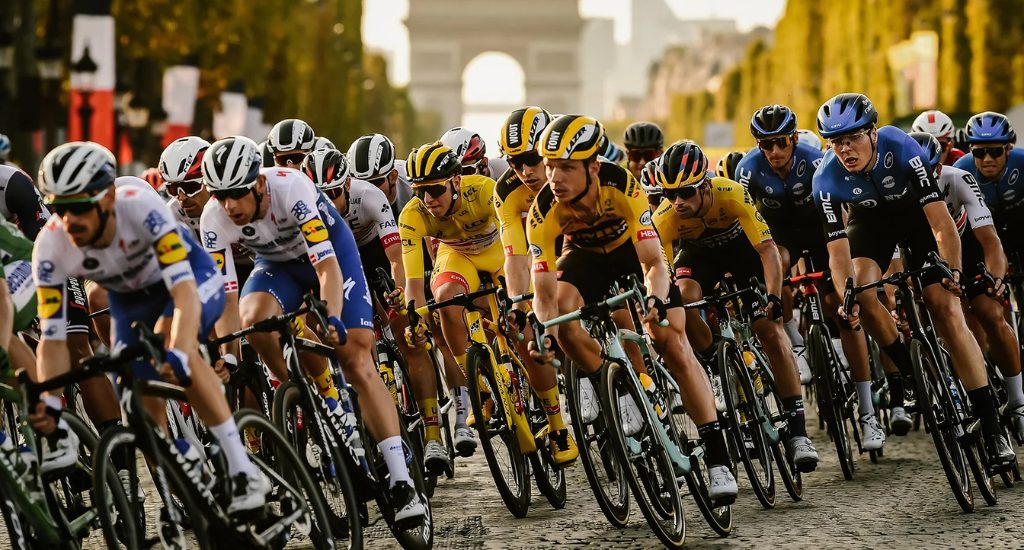
The Stage 21 finale combines tradition with innovation. The peloton rides the cobbled slopes of Rue Lepic three times through Montmartre, then continues 15 kilometers from Sacré-Cœur to the traditional Champs-Élysées finish. With the final Montmartre ascent positioned 15 kilometers from the finish line, race director Christian Prudhomme believes this placement keeps the outcome uncertain between puncheurs and sprinters – ensuring drama until the final meters in Paris.
| Date (2026) | Stage | Start | Finish | Distance | Type | Key notes |
| 4 Jul | S1 | Barcelona | Barcelona | 19.7 km | TTT | Montjuïc finish |
| 5 Jul | S2 | Tarragona | Barcelona | 178 km | Hilly | Begues climb, then Montjuïc repeats |
| 6 Jul | S3 | Granollers | Les Angles | 196 km | Mountain | Pyrenees crossing |
| 7 Jul | S4 | Carcassonne | Foix | 182 km | Hilly | Rolling GC day |
| 8 Jul | S5 | Lannemezan | Pau | 158 km | Flat | Sprint-friendly |
| 9 Jul | S6 | Pau | Gavarnie-Gèdre | 186 km | Mountain | Summit finish |
| 10 Jul | S7 | Hagetmau | Bordeaux | 175 km | Flat | Sprint-friendly |
| 11 Jul | S8 | Périgueux | Bergerac | 182 km | Flat | Sprint-friendly |
| 12 Jul | S9 | Malemort | Ussel | 185 km | Hilly | Punchy terrain |
| 13 Jul | Rest day | Cantal | Rest | First rest day | ||
| 14 Jul | S10 | Aurillac | Le Lioran | 167 km | Mountain | Massif Central finish |
| 15 Jul | S11 | Vichy | Nevers | 161 km | Flat | Sprint-friendly |
| 16 Jul | S12 | Nevers Magny-Cours | Chalon-sur-Saône | 181 km | Flat | Sprint-friendly |
| 17 Jul | S13 | Dole | Belfort | 205 km | Hilly | Long transition stage |
| 18 Jul | S14 | Mulhouse | Le Markstein Fellering | 155 km | Mountain | Vosges climbs |
| 19 Jul | S15 | Champagnole | Plateau de Solaison | 184 km | Mountain | Summit finish |
| 20 Jul | Rest day | Haute-Savoie | Rest | Second rest day | ||
| 21 Jul | S16 | Évian-les-Bains | Thonon-les-Bains | 26 km | ITT | Key GC test |
| 22 Jul | S17 | Chambéry | Voiron | 175 km | Flat | Sprint-friendly |
| 23 Jul | S18 | Voiron | Orcières-Merlette | 185 km | Mountain | Summit finish |
| 24 Jul | S19 | Gap | Alpe d’Huez | 128 km | Mountain | Summit finish |
| 25 Jul | S20 | Le Bourg-d’Oisans | Alpe d’Huez | 171 km | Mountain | Croix de Fer, Télégraphe, Galibier, Col de Sarenne, summit finish |
| 26 Jul | S21 | Thoiry | Paris Champs-Élysées | 130 km | Flat | Montmartre circuit included |
Teams & Contenders for Overall Victory
Tadej Pogačar enters Tour de France 2026 as the overwhelming GC favourite. The four-time champion targets a historic fifth yellow jersey, which would equal the record held by Eddy Merckx, Bernard Hinault, Jacques Anquetil, and Miguel Induráin. UAE Team Emirates-XRG provides dominant support, making this Tour Pogačar’s to lose before he turns a single pedal.
Jonas Vingegaard remains the most credible threat. The two-time Tour winner excels in grueling third weeks, and the 2026 route plays directly to that strength. Visma-Lease a Bike responded positively to the route announcement, noting multiple ambush opportunities on rolling terrain. The return to Le Lioran, where Vingegaard defeated Pogačar in 2024, adds psychological edge to his campaign.
Remco Evenepoel brings renewed ambition after joining Red Bull-Bora-Hansgrohe. The Belgian stated clearly that he wants to surpass Pogačar and believes he can win the Tour in 2026. He shares leadership duties with Florian Lipowitz, combining explosive power with diesel-like endurance for tactical flexibility.
Rising contenders include Juan Ayuso, targeting the overall classification for Lidl-Trek alongside Mads Pedersen. Team tactics will prove decisive: Red Bull-Bora-Hansgrohe’s dual-leader approach and Visma-Lease a Bike’s calculated patience could exploit any UAE vulnerabilities on ambush-friendly stages.
Strategic Features That Will Define the GC Battle
The team time trial on Stage 1 introduces a format not seen since 1971. Each rider receives an individual finish time rather than a shared team time. This change rewards GC contenders who can climb the Montjuïc hills at full speed while teammates fall away. Strong teams like UAE Team Emirates and Visma-Lease a Bike gain tactical options, while weaker squads risk losing a minute or more before the road stages begin.
The individual time trial arrives late on Stage 16, covering just 26 kilometers along Lake Geneva. This placement benefits climbers more than pure time-trial specialists. Cumulative fatigue from two weeks of racing often matters more than raw power against the clock. Remco Evenepoel holds the advantage here, but the rolling terrain, with a 9-kilometer opening climb, limits the potential for time gaps.
Five summit finishes create multiple opportunities for GC attacks. The back-to-back Alpe d’Huez stages on Days 19 and 20 will decide the yellow jersey. Stage 20 packs 5,600 meters of climbing into 171 kilometers, including the Galibier and Col de Sarenne. Breakaways have room to succeed on earlier mountain stages, but the final Alpine weekend demands direct confrontation between favorites.
New Rules & UCI Changes Affecting the 2026 Edition
UCI equipment regulations for 2026 bring major changes to professional cycling. Wheel rim depth is now capped at 65mm for mass-start road events, eliminating the ultra-deep aero wheels that dominated recent Tours. Handlebars must measure at least 400mm wide, with a minimum 280mm gap between brake levers. These safety-focused rules will affect bike handling on descents and in crosswinds.
Helmet categories are now split into two distinct types. Road helmets must have three visible vents, no ear coverage, and no visor. Time trial helmets remain unrestricted but can only be used during ITT and TTT stages. Riders like Victor Campenaerts will need different headgear for road stages.
The Tour de France itself introduces format changes beyond those mandated by the UCI. Seven flat stages will feature two intermediate sprints each, marking the biggest shake-up to the green jersey competition since 2011. This doubles the points available mid-stage and encourages more aggressive racing from sprinters. Time bonuses of 10, 6, and 4 seconds remain at stage finishes, but intermediate sprints offer no time bonuses for GC riders.