
What is the correct tire pressure for a mountain bike? It is one of the most common questions new and experienced riders ask, and the honest answer is that no single PSI works for everyone. Tire width, rider weight, tube setup, terrain, and even the weather all change what feels right underneath you.
Tire pressure of mountain bike setups depends on how these variables combine, which is why two riders on the same trail can run completely different numbers and both feel confident. As a general answer, mountain bike tire pressure usually falls between 18 and 30 PSI, though some riders land outside that range depending on their setup. The rear tire typically needs a bit more air than the front since it carries more of the rider’s weight.
This guide walks through each factor so you can find a starting pressure that fits your bike and riding style. Keep reading to build a setup that feels balanced on your usual trails.
What Is the Best Tire Pressure for a Mountain Bike?
Most riders start somewhere in the 18 to 30 PSI range, then adjust based on tire volume, weight, and terrain. This section breaks down the general guideline before narrowing things down further.
General Mountain Bike Tire Pressure Range
The 18 to 30 PSI range works as a general guideline rather than a fixed rule, since tire volume, rider weight, and terrain all shift the ideal number. Some riders measure in bar instead of PSI, where roughly 1 bar equals about 14.5 PSI. A practical baseline looks like this:
- Front: around 20 to 25 PSI
- Rear: around 25 to 30 PSI
Some riders run lower or higher than this depending on their specific tires and trail conditions.
Should the Front or Rear Tire Have More Pressure?
The rear tire usually carries more of the rider’s weight, especially under braking and while climbing, so it commonly runs 2 to 5 PSI higher than the front. This gap helps balance grip up front with stability in the rear. A few example setups:
- 21 PSI front, 23 PSI rear
- 20 PSI front, 25 PSI rear
- 25 PSI front, 30 PSI rear
The pressure difference affects both cornering grip and overall stability at speed.
How Tire Width Affects Mountain Bike Tire Pressure
Wider, higher-volume tires hold more air, which generally allows lower PSI without losing support. Tire sizes commonly fall into a few groups: 2.1 to 2.3 inches, 2.4 to 2.5 inches, and 2.6 inches and wider.
A 2.5-inch enduro tire may work well around 20 PSI for many riders. Width alone should not decide your final pressure, though, since rider weight and terrain still carry equal weight in that decision.
Tubeless vs. Tubed Mountain Bike Tires
Tubeless tires often allow lower pressure since there is no tube to pinch against the rim under impact. Lower tire pressure in mountain bike tubeless setups can improve grip, comfort, and control on rough trail sections. Many tubeless riders start around 25 PSI before fine-tuning from there.
Inner tube setups need firmer pressure to avoid pinch flats, while excessively low tubeless pressure risks rim strikes and tire burping in corners.
Mountain Bike Tire Pressure by Rider Weight and Tire Size
Rider weight and tire size both play a major role in choosing a personalized starting PSI. This section breaks down pressure ranges by weight group and tire width.
Tire Pressure for Lightweight Riders
Lighter riders can often run lower PSI since less weight presses down on the tire during each impact. Lower pressure improves traction and comfort on rough terrain without much added risk.
Pressure that drops too low still causes tire instability or rim damage, though, so a reasonable range based on tire width remains important. New riders shopping for the best mountain bike for beginners often overlook tire pressure entirely, yet it shapes how confident a first ride actually feels.
Tire Pressure for Average-Weight Riders
Average-weight riders can usually start near the middle of the recommended range, such as 20 to 25 PSI front and 23 to 30 PSI rear. From there, trail conditions guide small adjustments up or down. This starting point works well as a baseline before fine-tuning on familiar trails.
Tire Pressure for Heavier Riders
Heavier riders generally need higher PSI to avoid rim strikes, pinch flats, and tire squirm through corners. Simply lowering pressure to chase more grip often backfires for heavier riders, since the tire deforms too much under load.
Firmer pressure protects both the rim and the tire casing during hard impacts. Riders often ask how many pounds of pressure in a mountain bike tire they should carry once their weight climbs past the average range, and the honest answer usually sits closer to the top of the chart.
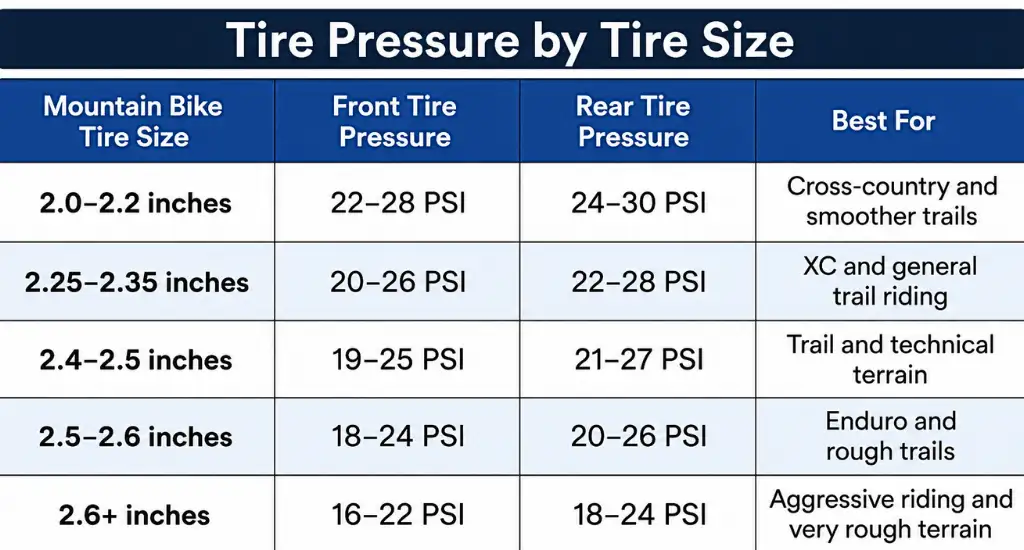
Tire Pressure by Tire Size
Tire volume changes the ideal PSI significantly across different categories. Narrower cross-country tires need firmer pressure than wider trail tires, while 2.4 to 2.5 inch trail tires and 2.5 to 2.6 inch enduro tires can often run softer. Wider tires frequently hold stability at lower pressure without sacrificing control.
Finding Your Personal Starting Pressure
Published pressure charts and online calculators offer a solid starting point, though your own trail testing matters more in the end. Adjust PSI in small increments, changing pressure by 1 to 2 PSI at a time. Evaluate how the bike feels after each change before making another adjustment.
How Terrain and Riding Style Affect Mountain Bike Tire Pressure
The same rider often needs different PSI depending on the trail and riding style for that day. Terrain and speed both shape how a tire should behave underneath you.
Smooth and hard-packed trails favor higher PSI, which improves rolling efficiency and reduces unnecessary tire deformation. This matters most for riders who occasionally pavement commute, since tire pressure for a mountain bike on road use calls for firmer numbers than any singletrack session would need.
Rocky and technical trails often benefit from slightly lower PSI, since the tire can conform to uneven surfaces, though too little pressure invites rim strikes. Rooty and rough terrain tends to reward lower pressure for extra grip and comfort.
Downhill and aggressive riding requires a balance between traction and rim protection, while cross-country riding often favors slightly higher pressure to cut down on rolling resistance. Wet trails benefit from lower pressure for grip, though riders should avoid going so low that the tire feels unstable through turns.
Riding speed and cornering force both influence the ideal PSI as well. The gap becomes obvious when comparing a mountain bike or Fixie on the same stretch of pavement, since a Fixie holds a fixed high pressure while a mountain bike’s ideal number shifts with every surface change.
In the end, tire pressure is always a compromise between grip, rolling resistance, comfort, stability, and protection against punctures or rim damage.
How to Find and Adjust the Right Tire Pressure
The best tire pressure is usually found through small adjustments rather than one perfect number pulled from a chart. This process helps you dial in a setup that matches your riding.
- Check the tire manufacturer’s recommended pressure range
- Start near the middle of the suggested PSI range
- Set the rear tire slightly higher than the front
- Use a reliable tire pressure gauge for consistent readings
- Test the bike on your usual trail
- Lower pressure by 1 to 2 PSI if the ride feels harsh or lacks traction
- Increase pressure if you experience rim strikes or tire squirm
- Increase pressure if the tire feels unstable during hard cornering
- Consider lower pressure when using wider tubeless tires
- Recheck pressure before every ride
- Keep notes about the PSI that works best for different trails
Riders switching between bike types sometimes ask whether a BMX Bike or Mountain Bike needs a different approach to pressure checks, and the answer is yes, since BMX tires run much higher and narrower pressure ranges built for jumps rather than traction.
Your ideal setup may shift over time as rider weight, tire wear, weather, and trail conditions change.
Conclusion
The answer to what the tire pressure of mountain bike setups comes down to is a general 18 to 30 PSI range that fits most riders as a starting point. Many begin around 20 to 25 PSI in the front and 25 to 30 PSI in the rear, then adjust from there based on feel.
Wider tires and tubeless setups often allow lower pressure, while rider weight and terrain matter just as much in the final decision.
Make small PSI adjustments over a few rides until the bike delivers the right balance of grip, control, speed, and rim protection. Tire pressure for mountain bike setups will never be one fixed number, but a starting range paired with careful testing gets you there quickly.
FAQs
What PSI should a mountain bike tire be?
Most mountain bike tires fall between 18 and 30 PSI, though the exact number depends on tire size, rider weight, and the terrain you ride most often.
Is 30 PSI too high for a mountain bike?
Not necessarily. Narrower tires, heavier riders, or smoother trails often suit 30 PSI without sacrificing comfort or control on the bike.
Is 20 PSI too low for a mountain bike?
It can work well for wider tires and tubeless setups, though it raises the risk of rim strikes and tire instability on rougher terrain.
Should mountain bike tires have the same PSI?
No. The rear tire commonly runs slightly higher than the front since it carries more of the rider's weight during climbs and braking.
What is the typical tire pressure of a mountain bike?
Most setups land between 18 and 30 PSI, with the front slightly softer than the rear, though tire width and rider weight shift the exact figure.
What PSI should I use for tubeless mountain bike tires?
Around 25 PSI works as a reasonable starting point, though tire width, rider weight, and terrain all shape the final pressure you settle on.


