
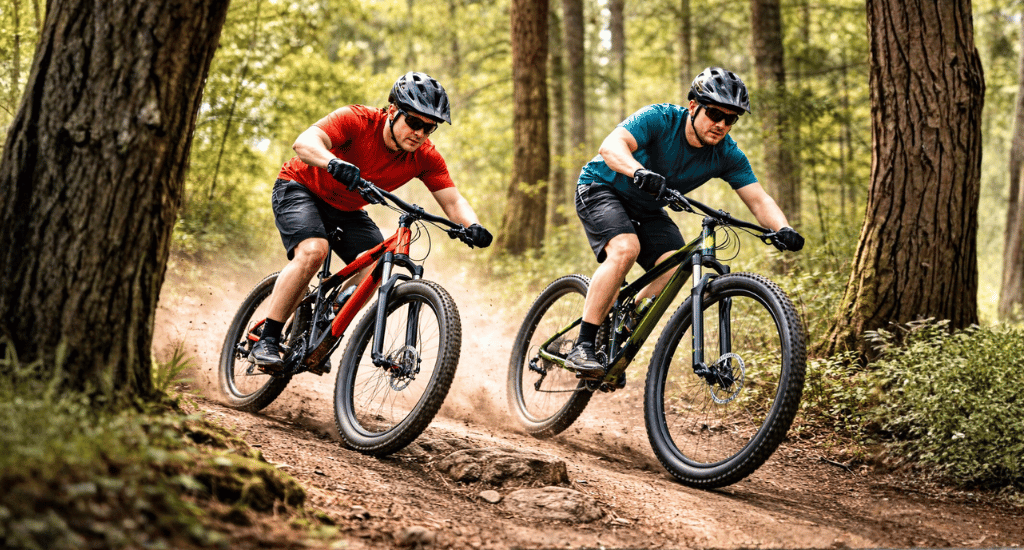
A 29-inch mountain bike rolls faster on rough trails than a 26-inch bike. The larger wheel crosses rocks and roots at a smoother angle. A 26-inch bike reacts faster through tight turns and sharp switchbacks.
I have ridden both wheel sizes across the Pacific Northwest singletrack for 22 years. The speed gap exists, but wheel size alone does not explain it. Modern 29ers carry 15 years of focused R&D in frame geometry, thru-axles, and tubeless tire systems. Those upgrades never reached 26-inch platforms. Most new 26-inch bikes now serve only dirt-jump riders.
Controlled tests show 29-inch bikes finish about 7.5 seconds faster on timed laps. That equals a 2.4 percent speed gain.
This guide compares speed, stability, handling, traction, and rider height fit for both wheel sizes.
Difference Between the 26 and 29 Inch Mountain Bike Wheels
This table compares 26-inch and 29-inch mountain bike wheels across 21 performance, handling, and market factors.
| Feature | 26-Inch Wheel | 29-Inch Wheel |
|---|---|---|
| Rim Diameter | 559 mm (ISO) | 622 mm (ISO) |
| Rolling Resistance | Higher on rough terrain | Lower on rough terrain |
| Rollover Ability | Drops into rocks and roots | Climbs over rocks and roots at a smoother angle |
| Acceleration | Faster spin-up from stops and corners | Slower initial spin-up, holds speed longer |
| Effective Gearing | Standard gear ratio | 12% higher effective gear with the same drivetrain |
| Traction (Contact Patch) | Narrower ground contact | Wider ground contact on loose and wet terrain |
| Low-PSI Performance | Limited by pinch flat risk on tubes | Stronger grip at 22-25 PSI on tubeless setups |
| Cornering Agility | Quick lean, light steering, less fatigue | More grip but heavier steering, more arm fatigue on long technical sections |
| Stability at Speed | Less stable on fast, rough descents | Tracks straighter through rough terrain at speed |
| Switchback Handling | Precise, quick direction changes | A wider turning radius requires more deliberate input |
| Jumping and Air Control | Less gyroscopic force, easier mid-air corrections | More stable in air but harder to adjust angles |
| Climbing Steep Terrain | A lighter wheel helps short, punchy climbs | A higher effective gear makes low-cadence steep climbs harder |
| Momentum on Root Sections | Loses speed at each root cluster | Maintains a rolling rhythm through consecutive roots |
| Wheel Weight (Avg) | Lighter due to shorter spokes and smaller rim | Heavier due to longer spokes and larger rim circle |
| Wheel Stiffness | Stiffer, shorter spoke triangulation | Slight flex under aggressive lateral loads |
| Tire Availability (2026) | Declining, tubeless trail tires hard to source | Full selection from all major brands |
| New Bike Production (2026) | Nearly discontinued, dirt jump niche only | Dominant wheel size across trail, XC, and enduro |
| Best Rider Height | Under 5’5″ (165 cm) | 5’6″ (168 cm) and taller |
| Standover Clearance | More clearance for shorter riders | Fat tires + raised BB eat 1-2″ of frame size |
| Best Trail Type | Tight technical singletrack, dirt jumps, flow trails | Cross-country, rocky terrain, root-heavy trails, long rides |
| Skill Development | Forces precise line selection and active body positioning | More forgiving, masks sloppy technique |
A 26-inch and 29-inch mountain bike handle rocks, roots, and turns differently. The difference starts at rim diameter but extends into frame design, rolling efficiency, and tire contact area. Each factor changes how a mountain bike feels at trail speed.
Wheel Size and Basic Design Difference
Wheel size refers to the diameter of the bike wheel with the tire installed. A 26-inch mountain bike uses a rim with a diameter of about 559 millimeters. A 29-inch mountain bike uses a larger rim with a diameter of around 622 millimeters.
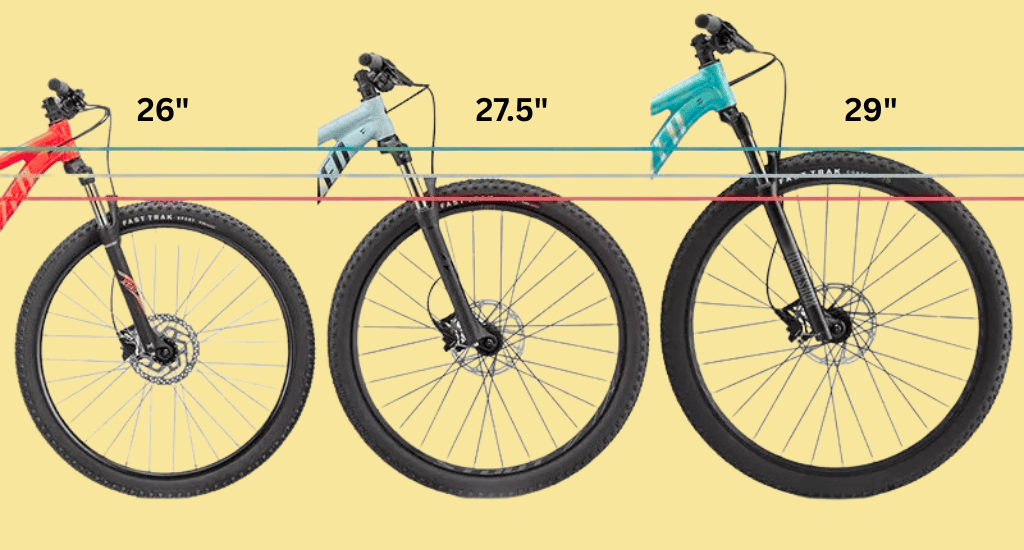
This change may appear small, yet it affects the bike frame and overall design. A larger wheel needs more space inside the frame, which increases the bike’s length slightly. The distance between the front and rear wheels, called the wheelbase, usually becomes longer.
A longer wheelbase often improves balance on rough trails. Many 29-inch bikes also use a taller front section to fit the bigger wheel properly.
Frame Geometry Matters More Than Wheel Size Alone
Frame geometry shapes ride feel more than rim diameter alone. Head tube angle, fork offset, chainstay length, and stem length control how a bike steers and corners. A narrow 29-inch tire at 2.1 inches measures close to a wide 27.5-inch tire at 2.6 inches. The rim size difference shrinks when tire width changes.
Development of 26-inch bike geometry stopped around 2010. Modern 29ers use updated frame designs, boost hub spacing, and optimized suspension kinematics. A 2010 cross-country 29er raced against a 2010 cross-country 26er would show a much smaller speed gap than most riders expect. The 15 years of R&D built around 29-inch wheels created the real performance difference.
Speed and Rolling Efficiency
Wheel size also affects how easily a bike moves across rough ground. A larger wheel climbs over rocks and roots with less effort. The tire meets obstacles at a smoother angle, which helps the bike roll forward easily.
A 29-inch tire rolls more easily than a 26-inch tire on both flat and rough terrain. The only trade-offs are slightly higher wheel mass and heavier steering feel through tight corners.
Rolling resistance also plays an important role in speed. This term describes how much energy a tire loses while moving across the ground. Larger wheels usually waste less energy during this motion.
A 29-inch wheel loses less speed when it contacts rocks and roots mid-climb. I notice this most on 20-minute climbs through root sections in the Pacific Northwest. The 29er holds pedaling rhythm while the 26-inch bike stutters at every root crossing. Each stutter costs 1 to 2 pedal strokes to recover rolling speed.
Many comparisons confirm this point. Reports often state that 29ers do have lower rolling resistance than their 26-inch equivalent.
Controlled trial tests by the Swiss national MTB team show a small speed difference. Riders on 29-inch bikes finished about 7.5 seconds faster, which equals nearly a 2.4 percent improvement.
Real Trail Performance: 26” vs 29” Side by Side
I tested both wheel sizes on the same Pacific Northwest trail loop across four terrain types.
Tight switchbacks: The 26-inch bike carved through each turn without effort. The 29er required more deliberate steering inputs through the same corners.
Consecutive root sections: The 29er held rolling speed through groups of roots. The 26-inch bike lost momentum at each root cluster and needed extra pedal strokes to recover.
Narrow stream crossing: The 26-inch bike handled the small, precise movements across wet rocks. The 29er overshot the narrow line on repeated attempts.
Steep root-crowned climb: The 29er rolled straight over the tangled root mat at the crest. The 26-inch bike stalled halfway up.
This pattern repeats across trail types. The 29er dominates where momentum and rollover matter. The 26-inch bike wins where precision and quick corrections matter.
Handling and Agility
Handling describes how quickly a bike reacts during turns and direction changes. Smaller wheels usually feel faster and more responsive in tight trail sections.
The compact wheel size allows quick movement when riders face sharp corners or narrow paths. Riders often feel more in control during technical trail sections.
Many riders describe the ride as feeling clear. 26-inch wheels will be more maneuverable and playful during jumps because the bike reacts faster.
Cornering Feel and Steering Fatigue
Larger tires grip more aggressively in corners. This extra traction limits how far a rider can lean the bike through turns. After a long section of tight switchbacks, 29er riders report more arm and shoulder fatigue from heavier steering. A 26-inch bike flicks through corners with less physical effort. Riders who prioritize technical trails with continuous direction changes find 26-inch handling less tiring over a full ride.
Acceleration and Momentum
Smaller wheels accelerate faster out of corners and short climbs. Most riders blame wheel diameter, but wheel weight causes the difference, not size. A 29-inch wheel built with carbon rims and tubeless tires accelerates close to a heavier 26-inch wheel with aluminum rims and tubes.
A 29er acts as an effective 12 percent higher gear with the same drivetrain. Each pedal stroke covers more ground on a 29-inch wheel. This higher effective gear makes steep technical climbs harder at low cadence. On flat or rolling terrain, the same gearing advantage helps the 29er maintain speed with fewer pedal strokes.
Traction and Climbing Performance
Traction describes how well a tire grips the ground. A larger wheel usually touches the trail across a wider area.
This type of wider contact patch improves grip on loose dirt, gravel, or wet ground. A strong grip can help riders climb steep hills with better control.
Tire pressure amplifies the traction gap between wheel sizes. A 29-inch tubeless tire run at 22 to 25 PSI spreads a wider contact patch across loose dirt, sand, and wet roots. The same low pressure on a 26-inch tire risks pinch flats on tube setups and rim damage on narrower rims. Riders who drop 29er tire pressure on tubeless setups unlock stronger grip on loose climbs than any pressure adjustment on a 26-inch wheel achieves.
Bike Weight and Strength
Wheel size also affects bike weight and structure. A 26-inch wheel uses shorter spokes and a smaller rim circle. This design often creates a lighter and stiffer wheel.
A 29-inch wheel uses longer spokes and a larger rim. This structure can add a small amount of weight and slight flex during aggressive riding.
Both wheel sizes remain durable for normal trail use, yet their ride feel differs because of size and structure.
Are 26-Inch Mountain Bikes Still Relevant Today?
A 26-inch mountain bike still serves specific riders and riding styles in 2026. Most brands have stopped producing new 26-inch models. Parts availability continues to shrink. The wheel size remains useful for dirt jumping, budget builds, and skill development on hardtail frames.
Declining Market Availability
Most major bike brands stopped releasing new 26-inch mountain bikes after 2015. Retailers now stock 27.5-inch and 29-inch bike components almost exclusively. Finding quality 26-inch replacement parts requires extra effort in 2026.
Tubeless-ready trail tires present the biggest sourcing problem. Major brands like Maxxis face months-long wait times for 26-inch tubeless models in North America. European riders still access 26-inch tires from Schwalbe and Continental. Vittoria dropped the 26-inch size entirely from its lineup.
Budget commuter tires and basic tubes remain available at most shops. Performance rubber for aggressive trail riding is the category that has nearly disappeared.
Resale value on used 26-inch bikes continues to drop each year. A comparable 29er holds roughly 20 to 30 percent more resale value on the used market.
Situations Where 26-Inch Bikes Still Make Sense
Even with these changes, 26-inch bikes still work well for several riders.
They remain popular for:
- Dirt jump trails that require quick control
- Budget mountain bikes with lower prices
- Youth riders who need smaller frames
- Riders who prefer agile and responsive handling
The 26-inch mountain bike may be less common today, yet it still offers a fun and capable ride for many trail styles.
26-Inch Hardtails Build Better Riding Skills
A 26-inch hardtail forces precise line selection and active body positioning. The smaller wheels punish sloppy technique on rough terrain. Every missed line costs visible speed.
I recommend new riders spend at least one season on a 26-inch hardtail before moving to a 29er full-suspension bike. The skills transfer directly to any future bike. Modern 29er enduro bikes on built trails mask technique gaps. A 26-inch hardtail does not forgive those same mistakes.
How to Choose Between a 26” and 29” Mountain Bike
The right wheel size depends on trail type, riding style, and body size.
Choose a 29-inch bike for cross-country trails, rocky or root-filled terrain, and rides longer than 10 miles. The larger wheel maintains speed over rough ground and provides stronger traction on loose dirt. Riders 5’6″ and taller fit 29-inch frame proportions comfortably.
Choose a 26-inch bike for dirt jumps, tight technical singletrack, and flow trails. The smaller wheel accelerates faster out of corners and responds quickly through sharp switchbacks. Riders under 5’5″ benefit from the lower standover height and compact frame geometry.
A mullet setup pairs a 29-inch front wheel with a 27.5-inch rear wheel. This combination gives front-wheel rollover stability with rear-end agility through turns. Several major brands now offer mullet-compatible frames for riders who want both advantages.
Test both wheel sizes on the same trail before buying. Ride feel depends heavily on the bike geometry you already know.
End Note
A 29-inch bike suits riders who value speed and stability on rough trails. A 26-inch bike rewards riders who prioritize agility and technical control. Match the wheel size to your trail type and body size before buying.
FAQs
Is a 29 mountain bike faster than a 26?
Yes, many tests show a small speed advantage for larger wheels. Controlled comparisons reported about 2.4 percent faster results, with riders finishing roughly 7.5 seconds quicker because larger wheels roll more efficiently.
Are 26-inch mountain bikes outdated?
Not completely. They appear less often in new bike releases today, yet many riders still use them. Dirt jump bikes, technical trail bikes, and budget mountain bikes often continue using 26-inch wheels.
Is a 29-inch bike too big for shorter riders?
It can feel large for riders under 5'5" because the wheel size raises the bike height. However, many modern frames now use compact geometry that helps shorter riders ride 29-inch bikes comfortably.


