
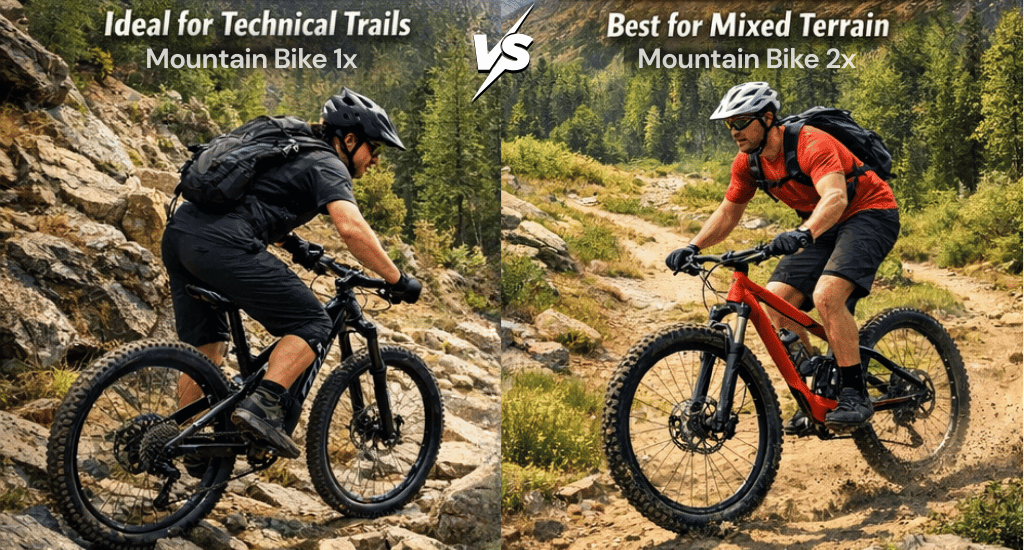
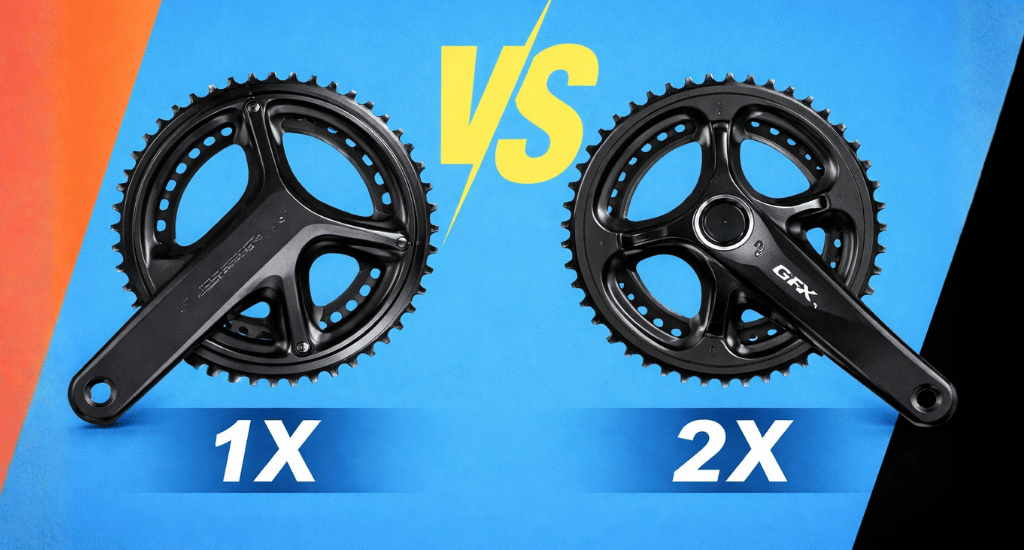
A 1x drivetrain uses one front chainring. A 2x drivetrain uses two. This difference changes gear range, shifting feel, chain security, and maintenance.
I have ridden both setups across the Pacific Northwest singletrack for over two decades. Most modern mountain bikes now ship with 1x drivetrains. Gravel, touring, and some XC bikes still use 2x for a wider gear range and smoother cadence.
This guide compares 1x vs 2x drivetrains to help you choose the right setup for your terrain and riding style, focusing on gear range, efficiency, weight, chain retention, and cost.
What Is a 1x and 2x Drivetrain?
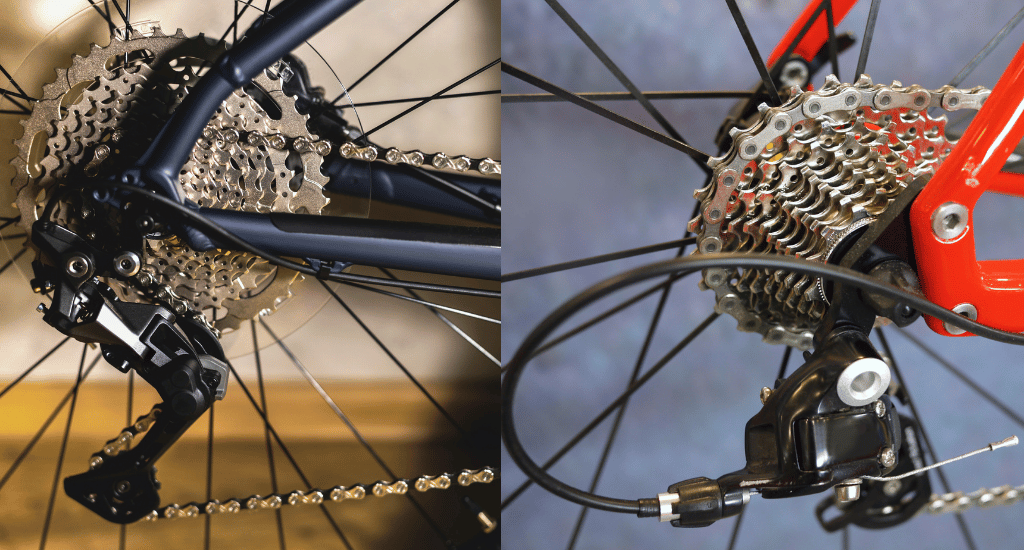
A 1x drivetrain uses one front chainring paired with a wide-range rear cassette. Common setups pair a 30T or 32T chainring with a 10-52T cassette, providing 12 gears via a single rear shifter. No front derailleur exists. A narrow-wide chainring and clutch rear derailleur keep the chain secure on rough trails.
A 2x drivetrain uses two front chainrings, typically 26-36T or 24-38T, paired with an 11-34T rear cassette. A front derailleur shifts the chain between rings, creating 20+ gear combinations with smaller gear spacing.
Dropping to a smaller front ring instantly shifts the gear range with one click. On a 1x, reaching the same range change means clicking through several rear cogs one at a time.
Check out our article on 1x vs 2x vs 3x mountain bike.
Difference Between 1x and 2x Drivetrain Mountain Bike
This section compares how 1x and 2x drivetrains feel in real riding. Each point clearly and practically explains use, gears, weight, reliability, and care needs.
A. Purpose & Common Use Cases
Drivetrain choice depends on ride type and trail conditions. Riders logging short technical laps need different gearing than those covering 20+ mile mixed-terrain days. The table below breaks down real use cases for each setup.
| Riding Scenario | Best Fit |
|---|---|
| Enduro or downhill trail laps under 10 miles | 1x – chain security matters more than range |
| Cross-country races on rolling singletrack | 1x – lighter weight aids climbing and acceleration |
| Bikepacking or multi-day mixed-terrain tours | 2x – wider range spares your knees on long climbs |
| Paved-to-gravel commuter routes | 2x – smaller gear steps hold steady cadence |
| New riders learning gear mechanics | 1x – one shifter reduces decision fatigue |
B. Gear Range Differences
Gear range measures the spread between your easiest and hardest gear. The formula changes depending on drivetrain type.
A 1x drivetrain calculates range by dividing the largest rear cog by the smallest. A 10-42T cassette produces a 420 percent range.
A 2x drivetrain multiplies front and rear ratios. Divide your largest front ring by the smallest rear cog, then divide that by your smallest front ring divided by your largest rear cog. A 48/31T front paired with an 11-34T rear produces a 480 percent range.
I run a mullet setup on my own trail bike, a road shifter paired with a mountain rear derailleur and cassette. This combination reaches a 556 percent range on a single chainring, the widest range of any setup I have tested. Setup takes patience and the right compatible parts, but the climbing range is worth it on steep Cascade fire roads.
Component compatibility for mullet builds has improved significantly through 2026, making this setup easier to source than it was even two years ago.
C. Gear Steps and Cadence Feel
Gear steps measure the percent jump between adjacent gears. An 11-42T 1x cassette jumps in increments of 42-37-32-28 teeth: three 5-tooth jumps and one 4-tooth jump. An 11-34T 2x-paired cassette jumps 34-30-27-25 teeth smaller, with more even steps throughout.
These larger 1x jumps show up most on smooth climbs and flat roads, where cadence consistency matters. On rough singletrack, riders focus on line choice and balance, so larger steps matter less. A 2x drivetrain holds steadier cadence on long, steady-effort rides.
D. Efficiency and Power Loss
Extreme cross-chaining on wide-range 1x cassettes increases chain angle and friction. This costs roughly 2 to 3 percent more pedaling power than a 2x drivetrain at the extreme ends of the cassette. A 2x system spreads the load across two chainrings with less extreme gearing, which also reduces long-term wear on the chain, cassette, and chainrings.
This efficiency gap stays small for most trail riding. It matters more on long climbs and endurance rides where every watt counts.
E. Weight and Bike Simplicity
A 1x setup removes the front derailleur, extra chainring, and second shifter. Fewer parts make the bike lighter. Less weight helps the bike feel quick and easy during climbs and sharp turns.
A lighter bike feels easier to control on trails. Steering reacts faster, and effort feels lower. A 2x bike carries more parts, which adds weight and makes the frame area feel crowded.
F. Reliability and Chain Retention
A narrow-wide chainring has teeth that grip the chain firmly. This design keeps the chain stable on bumps. It helps the 1x drivetrain stay secure on rocky and root-filled trails.
A clutch rear derailleur adds tension to the chain. This tension reduces chain slap and drops. With no front derailleur, the 1x setup drops the chain less often on rough terrain.
A 2x drivetrain offers one backup advantage: if the rear derailleur cable snaps mid-ride, the front derailleur still gives two usable gear combinations to get home. A 1x failure leaves you stuck in a single gear.
I dropped a chain twice in one ride on my old 2x setup, climbing loose switchbacks near Mount Hood. Since switching that bike to 1x with a clutch derailleur, I haven’t dropped a chain in over 3,000 trail miles.
G. Maintenance and Setup Complexity
A 1x drivetrain needs less care. Cleaning feels simple since fewer parts collect dirt. Gear setup also feels easier because there is only one shifter and no front adjustment work.
A 2x drivetrain needs more attention. Front derailleur alignment takes time and care. With long-term use, extra parts mean more tuning and cleaning, and a higher risk of minor mechanical issues.
Check out our article on 1x vs 3x mountain bike.
Pros and Cons of 1x vs 2x Mountain Bike Drivetrains
Both drivetrain types bring clear strengths and limits. The right choice depends on ride length, terrain type, and comfort needs. This section shows the benefits and downsides in a simple, honest way.
1x Drivetrain Pros and Cons
A 1x drivetrain trades gear range for simplicity and chain security. Riders who spend most of their time on rough, technical trails benefit most from this setup. The table below breaks down where 1x wins and where it falls short.
| 1x Pros | 1x Cons |
|---|---|
| One shifter, simpler gear control | Larger jumps between gears (14-15% steps) |
| 200-450 grams lighter than 2x | Smaller total gear range on standard cassettes |
| Stronger chain retention on rough trails | 2-3% more power loss from chain angle |
| Less maintenance, no front derailleur to tune | Harder to hold a steady cadence on smooth climbs |
| Frees up handlebar space for a dropper post | Costs $50-100 more for equivalent groupset tier |
2x Drivetrain Pros and Cons
A 2x drivetrain trades simplicity for range and control. Riders who cover long distances across mixed terrain benefit most from the extra chainring. The table below breaks down where 2x wins and where it falls short.
| 2x Pros | 2x Cons |
|---|---|
| Wider total gear range for climbs and descents | Front derailleur needs regular alignment and tuning |
| Smaller, smoother steps between gears | 200-450 grams heavier than 1x |
| Better pedaling efficiency, less chain-angle friction | More parts increase the chance of mechanical issues |
| Backup gear if the rear derailleur cable fails | Front shifter takes up handlebar space |
| Lower-cost cassette replacement | Two shifters to manage while riding |
1x vs. 2x Drivetrain Bike: Which One Should You Choose?
Most 2026 mountain bikes ship with 1x drivetrains as standard, so this choice mainly applies to older bikes or custom builds.
Choose 1x if you ride enduro, downhill, or technical trail bikes and want chain security and simple one-hand shifting on rough terrain. A 1x setup also frees up handlebar space for a dropper post remote.
Choose 2x if you ride gravel, touring, or mixed-surface routes with long climbs. Wider range and smaller gear steps keep cadence steady across changing terrain. A 2x setup also gives you backup gear if the rear derailleur fails mid-ride.
On technical singletrack, 1x feels direct and secure. On long mixed-terrain rides, 2x feels smoother and more efficient. Choose the drivetrain that fits where you actually ride, not the trend.
Conclusion
A 1x drivetrain suits trail riders who value simplicity and chain security. A 2x drivetrain suits riders who need a wide gear range and smooth cadence on long, mixed-terrain rides. Match the setup to your terrain, not to trends.
FAQs
What Does 1x and 2x Mean on a Mountain Bike?
The number refers to front chainrings. A 1x drivetrain has one front chainring. A 2x drivetrain has two. A 1x12 setup means 1 front ring and 12 rear gears.
Is 1x Better Than 2x for Mountain Biking?
A 1x drivetrain suits most mountain bike trail riding in 2026. Chain retention and simple shifting outperform 2x on rough terrain. A 2x still wins for gravel or XC riders who need maximum gear range on long, mixed-surface rides.
Does 1x Lose Power Compared to 2x?
A 1x drivetrain loses roughly 2 to 3 percent in pedaling efficiency compared to a 2x at extreme gear combinations, due to increased chain angle. This difference is minor for most trail riding but adds up on long endurance climbs.
Can I Convert My 2x Bike to 1x?
Yes. Remove the front derailleur, small chainring, and front shifter. Install a narrow-wide chainring and a clutch-equipped rear derailleur if the current one lacks a clutch. Conversion costs $50 to $150 using compatible existing components.


